Read Genesis 1:1–1:27.
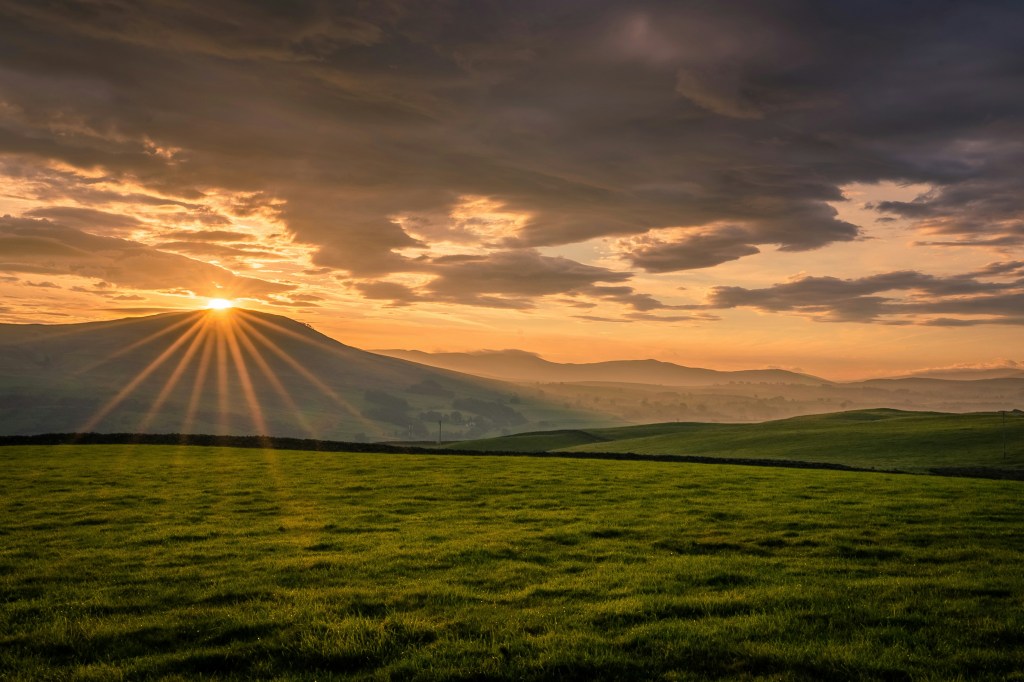
Look up at the stars. They have a story to tell. Listen to the sound of leaves crunching beneath your feet on a wooded trail. They, too, have something to say. You can hear it in the songs the birds each morning and the babble of a brook after a heavy rain. All of nature speaks to us of the Creator. But God isn’t one to play hard to get. He isn’t content to let the sunsets or the snowfalls do all the talking for Him. He wants His estranged children to know Him, and so He speaks to the world through the pages of the Bible. Thus, the opening of the book of Genesis is God’s grand introduction. It’s His way of saying hello, of taking us by the hand and letting us know who He is.
For starters, He’s the maker of all things, the one from whom all good things flow into our lives. He imagined, designed, and crafted into being all that there is. By His unfathomable power, everything was birthed from nothing.
Many of us stop there. God is creator, and everything He created is good. The world He made was perfect, glorious and magical in every sense. We’ve heard what happens next in the story: the first humans disobeyed the Lord and brought sin into the world. And so, paradise crumbled, and the goodness faded. That’s why the world we live in today looks so different than the perfect world we picture in our minds.
But let’s take a closer look. Nowhere does the Bible say God created a “perfect” world. It was good—even “very good” (Genesis 1:31), but it’s never described as impeccable. In fact, if we look at the creation account carefully, we’ll discover the universe was not perfect by any stretch of the imagination. Genesis 1:2 says that when God created the world, “the earth was formless and empty.” It was hardly a utopia.
The rest of Genesis 1 describes God’s “fixing” of creation. Step by step, He gave form to the formless and filled the emptiness. Concerning form, He separated light from day (vv. 3–5), divided the waters below from the waters above (vv. 6–8), and collected the seas so that dry ground appeared (vv. 9–10). Then, to alleviate the emptiness, He filled the heavens with more stars than we can count, plus the sun and moon (vv. 14–19); He poured fished into the sea and set birds aloft in the sky (vv. 20–23); and then He populated the land with animals of every kind—and the first human beings (vv. 24–27).
Human beings, however, are different. Contrary to what some of history’s greatest villains have suggested, we’re more than high-functioning animals. People—male and female—were made “in the image of God” (v. 27). Libraries have been filled with attempts to unpack that short phrase, but in the simplest of terms, it means we were made to be just like our Father. The rest of the Bible will unravel the mystery of what God is really like, but here in Genesis 1 we’ve already been given a lot to go on.
We were designed to be creative just like our Dad. But creativity isn’t limited to the ceiling of the Sistine Chapel or the halls of the Louvre. It’s everywhere—all around us. Whenever someone completes a job with excellence, they reflect the good Lord’s work during the six days of creation. And whenever a person sees a problem and fixes it, they mirror their heavenly Father. Whether it’s a leaky sink, a child in danger, or a community trapped in poverty, God’s heart is to bring healing and wholeness to each situation. And more often than not, He chooses to use ordinary people to do so.
There is no great divide between sacred callings and secular jobs. The role of a pastor is no holier than that of a plumber. All work is hallowed if it’s done with the heart of God through eyes of faith. In fact, every time you enter a room, you have an opportunity to change the world, if only a little bit. Just look for the places that need fixing. It’s there, in those gaps, that you’ll find your calling as a child of God.
 Pages of Joy // John Greco
Leave a comment